-
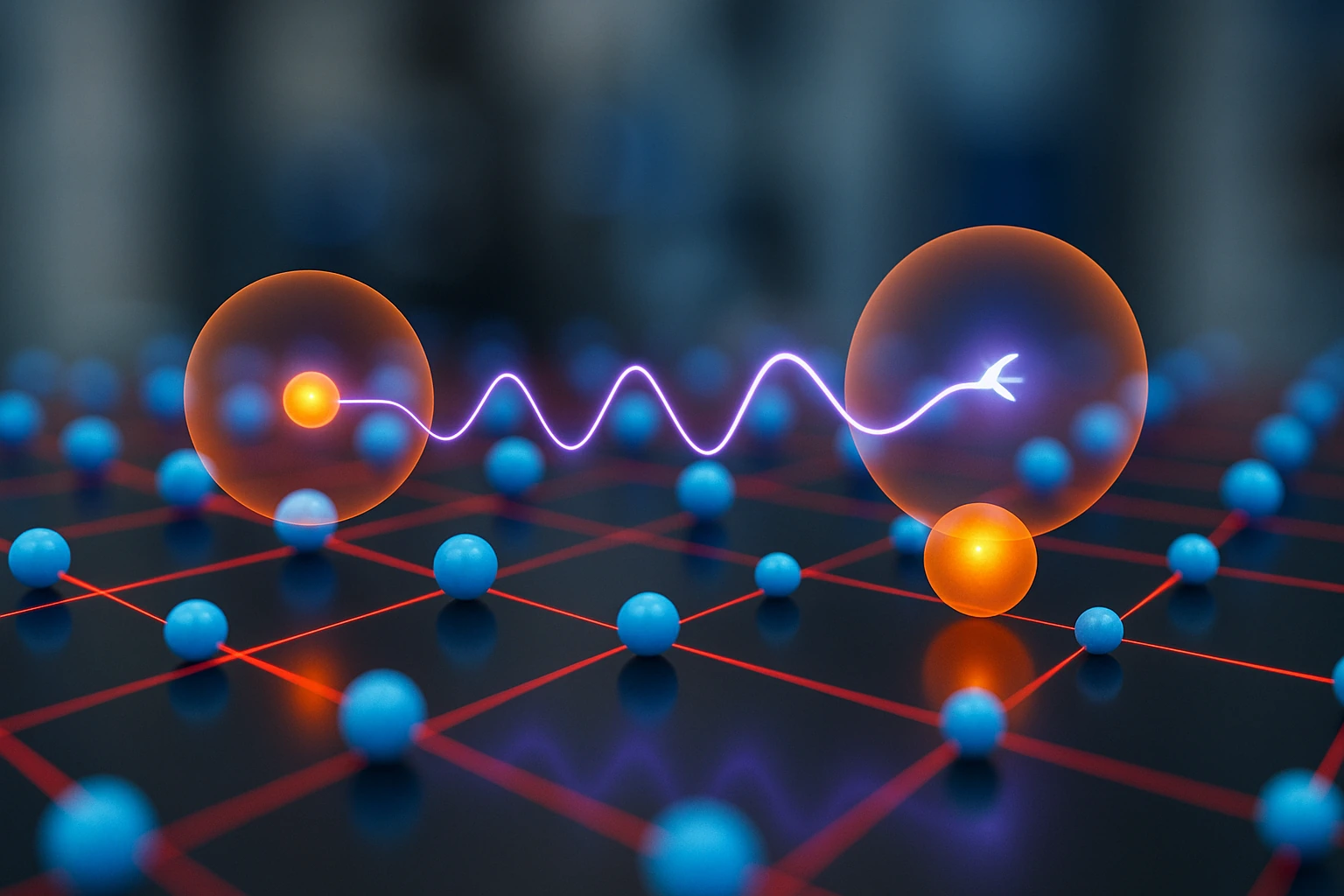
Rydberg Blockade and Quantum Gates: From Giant Atoms to Computation
Why Rydberg Atoms Matter Right Now Rydberg atoms are ordinary neutral atoms—rubidium, cesium, and friends—promoted to states of very high principal quantum number nnn. Their valence electron orbits far from the nucleus, ballooning the atom’s size by n2n^2n2 and supercharging properties that are otherwise tiny: polarizability scales roughly as n7n^7n7, dipole matrix elements as n2n^2n2,…
-

Keldysh Parameter Demystified: Mapping the Border Between Multiphoton and Tunneling Ionization
Why This Number Matters In strong-field atomic physics, one small, dimensionless number quietly decides how matter parts ways with its electrons. That number—the Keldysh parameter, γ—tells us whether an atom in an intense laser field loses an electron by climbing a photon “staircase” (multiphoton ionization) or by slipping through a field-suppressed barrier (tunneling ionization). Knowing…
-

Revival Phenomena in Strong-Field Atomic Systems
Unveiling the Quantum Rhythm In the strange and beautiful world of quantum physics, few effects are as elegant — and as telling — as revival phenomena. These are events where an electron’s wave-like behavior, seemingly dispersed and lost, reforms itself into its original shape after a period of time. This remarkable occurrence is known as…
-

Understanding Rydberg Atoms: The Giants of Atomic Physics
What Are Rydberg Atoms? In the world of atomic physics, Rydberg atoms are among the most intriguing and unusual species. Named after the Swedish physicist Johannes Rydberg, these are atoms with at least one electron that has been excited to a very high energy level, far from the nucleus. This results in atoms that are…
-

What Is Multiphoton Ionization and Why Does It Matter?
A New Way to Free Electrons When we think of ionizing an atom—removing one of its electrons—the typical image is a single, high-energy photon doing the job. But in the realm of strong laser fields and atomic physics, there’s a more fascinating mechanism: multiphoton ionization. This process occurs when multiple low-energy photons work together to…